Toy Story 3
Vibe
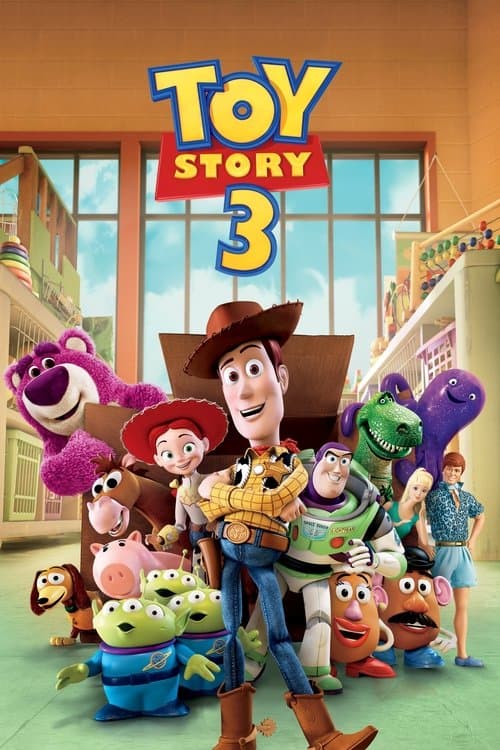
Pixar’s third installment finds Woody, Buzz, and the rest of Andy’s toys facing an uncertain future as their owner prepares to leave for college, forcing them to confront the possibility of being left behind. After a mix-up sends them to a daycare center, what initially appears to be a fresh start quickly reveals a rigid and oppressive system controlled by the deceptively gentle Lotso. As the group struggles to escape and return home, Woody must decide whether his loyalty lies with Andy or with the toys who depend on him. Directed by Lee Unkrich, the film balances humor, suspense, and emotional weight, building toward a powerful meditation on change, loyalty, and letting go. Toy Story 3 stands as a rare sequel that deepens its characters while delivering a meaningful sense of closure.
Watch for
- The daycare’s initial warmth contrasted with its underlying structure, revealing a system built on control and hierarchy.
- Lotso’s character and backstory, which reframe the film’s themes of abandonment and resentment.
- The group’s escape sequence, blending tension, humor, and precise coordination.
- The final moments between Andy and the toys, where themes of closure, identity, and letting go come fully into focus.
Production notes
Toy Story 3 was directed by Lee Unkrich (a longtime Pixar editor and co-director on Monsters, Inc., Finding Nemo, and Toy Story 2) and produced 11 years after Toy Story 2 — the gap deliberately allowing the original film's child audience to age into young adults whose actual emotional experience of leaving home would mirror Andy's. The film was originally developed by Disney's Circle 7 Animation, a post-Pixar-acquisition spinoff intended to make sequels to Pixar films without Pixar's involvement; after Disney acquired Pixar in 2006 and brought John Lasseter in as creative head, Circle 7 was dissolved and Pixar took over the project. Most of the original voice cast returned — Tom Hanks, Tim Allen, Joan Cusack, Don Rickles, Wallace Shawn, John Ratzenberger — joined by Ned Beatty as Lotso, Michael Keaton as Ken, and Whoopi Goldberg as Stretch. The film cost approximately $200 million.
Trivia
- Toy Story 3 was originally developed at Circle 7 Animation, a Disney studio formed in 2005 specifically to make Pixar sequels without Pixar; the project was scrapped when Disney acquired Pixar in 2006, and the entire script was rewritten from scratch by the original Pixar team.
- The film's incinerator sequence — in which the toys join hands and accept their fate as they slide toward the flames — is widely considered one of the most genuinely shocking moments in any animated family film, and was reportedly the source of producer pushback during development.
- Don Rickles, the original voice of Mr. Potato Head, was 84 when he recorded his Toy Story 3 dialogue; he died in 2017 and was the first major Toy Story voice actor lost between the third and fourth films.
- The film's opening sequence — a fully imagined Wild West fantasy starring all the toys — was originally the entire framing device for the film before Lee Unkrich shortened it to approximately three minutes.
- Toy Story 3 was the first animated film to gross over $1 billion worldwide, and held the title of highest-grossing animated film of all time until Frozen surpassed it in 2014.
Legacy
Toy Story 3 stands as one of the rare third installments to be genuinely beloved — the film that completed its franchise with the kind of emotional and structural confidence usually reserved for great novel sequences. It became the highest-grossing animated film of all time on initial release with over $1.07 billion worldwide, and won two Academy Awards (Best Animated Feature, Best Original Song for Randy Newman's 'We Belong Together'), with three additional nominations including Best Picture (only the third animated film ever nominated, and only the second since the category's expansion). The film entered the National Film Registry in 2024. Critics and audiences treated the ending — Andy giving his toys to Bonnie — as one of the most emotionally complete conclusions to any modern franchise, and the film became a generational touchstone for viewers who had grown up with Woody and Buzz across 15 years. The franchise's ability to grow with its audience has been studied as a template for long-form character-driven storytelling, and the 'we belong together' theme has anchored subsequent Toy Story projects.