Toy Story
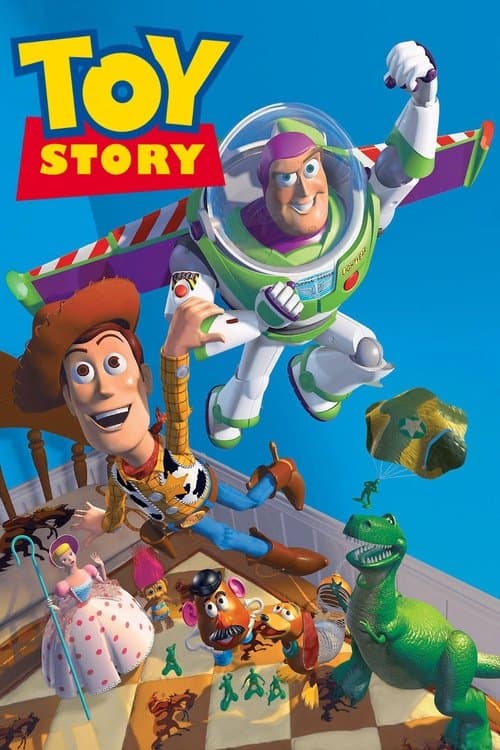
Vibe
Pixar's debut feature follows Woody, a beloved cowboy doll who reigns as the favorite toy in young Andy's bedroom — until the arrival of a flashy new space ranger named Buzz Lightyear upends the toy hierarchy and sends both characters tumbling into a series of mishaps in the world beyond Andy's room. Directed by John Lasseter and built around the ingenious premise that toys are alive and have inner lives the moment humans leave the room, the film transforms a simple childhood fantasy into a story about jealousy, identity, and the deep loyalties that develop between unlikely friends. As Woody and Buzz are forced to work together to find their way home, their initial rivalry deepens into something more durable. Beneath its breakthrough computer-animated surface lies a perfectly classical buddy comedy about ego, belonging, and the fear of being replaced.
Watch for
- The evolving dynamic between Woody and Buzz, shifting from rivalry to genuine friendship as their perspectives change.
- Buzz Lightyear’s gradual realization that he is a toy, a turning point that grounds the film’s emotional core.
- The detailed world-building that presents everyday environments from a toy’s point of view, adding both scale and wonder.
- The climactic rescue sequence, where teamwork and trust bring the story’s themes of loyalty and belonging into focus.
Production notes
Toy Story was Pixar's first feature film and the first feature film of any kind animated entirely on computer. Director John Lasseter, head of story Joe Ranft, and writers Andrew Stanton, Pete Docter, Joel Cohen, and Alec Sokolow developed the script through a famously turbulent process that included Disney executive Jeffrey Katzenberg ordering a 'Black Friday' shutdown of production in November 1993 after early footage tested poorly. The team rewrote the screenplay over two weeks and resumed in early 1994 with a new tone. Tom Hanks voiced Woody and Tim Allen played Buzz Lightyear, with Don Rickles, Jim Varney, Wallace Shawn, and John Ratzenberger filling out the toy ensemble. Randy Newman composed the score, recorded with a 95-piece orchestra, and wrote 'You've Got a Friend in Me,' which would become Pixar's signature song. The film cost roughly $30 million on a tight 18-month production schedule once the script was approved.
Trivia
- The 'Black Friday' shutdown of November 1993 nearly killed the project entirely; Disney executives told the team that if the rewrite didn't fix the screenplay, the film would be cancelled and Pixar would likely close.
- Buzz Lightyear was named after astronaut Buzz Aldrin, and at one point the character was going to be named 'Lunar Larry' before the team settled on the Aldrin tribute.
- Woody's design went through dramatic changes — early versions had him as a much sharper, more cynical ventriloquist's dummy, which test screenings rejected as unlikable.
- Pixar's animators rendered the film's 77 minutes from approximately 800,000 individual frames, each requiring an average of 4 to 6 hours of computing time on the studio's render farm.
- Tom Hanks recorded much of his Woody dialogue in a single weekend at a New York studio because he was in town shooting Forrest Gump and could only spare limited time.
Legacy
Toy Story marked a turning point in cinema as the first fully computer-animated feature film, proving that digital animation could support emotionally rich, character-driven storytelling and not merely function as a technical novelty. Its $373 million worldwide gross on a $30 million budget made it the highest-grossing film of 1995, and it earned three Academy Award nominations (the first time any animated film was nominated for Best Original Screenplay). John Lasseter received a Special Achievement Oscar for leading the production. The film entered the National Film Registry in 2005 and was selected to the AFI Top 10 Animated Films list in 2008. Beyond its records, Toy Story established Pixar's storytelling philosophy — technology in service of character, humor balanced with heart, universal themes of identity and belonging — and built the institutional template every subsequent Pixar film has refined. The franchise has grown to include four sequels (the fifth releases June 2026), multiple short films, theme park lands at every major Disney park, and one of the most valuable character-licensing operations in the entertainment business.