Luca
Vibe
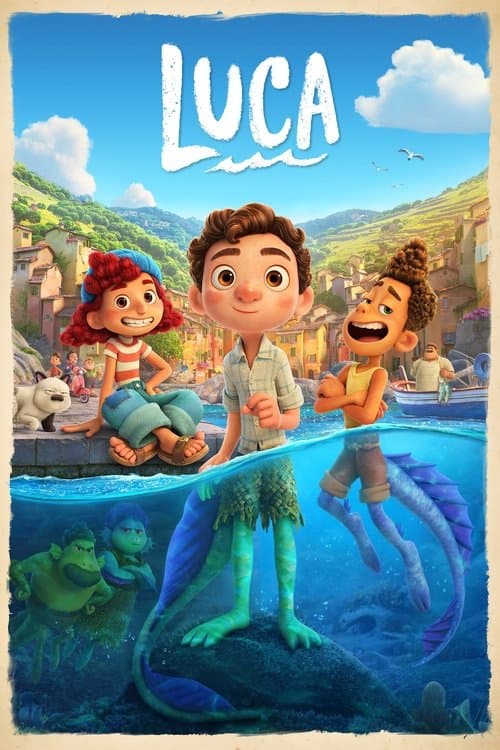
Pixar’s sun-drenched coming-of-age tale follows Luca, a curious sea monster who ventures onto land and discovers a seaside Italian town filled with possibility, friendship, and freedom. Alongside his adventurous new friend Alberto, Luca embraces a human life filled with simple joys, from gelato to Vespa dreams, while hiding his true identity from a world that fears what it does not understand. As their bond is tested by ambition, insecurity, and the pressures of belonging, Luca must decide who he wants to be and where he truly belongs. Directed by Enrico Casarosa, the film blends nostalgic charm with emotional sincerity, becoming a gentle story about identity, acceptance, and the courage to step beyond fear.
Watch for
- Luca and Alberto’s friendship, capturing the excitement and fragility of early connection.
- The transformation between sea monster and human form, symbolizing identity and self-perception.
- The small-town setting, which reinforces themes of community, exclusion, and discovery.
- The moments of choice, where Luca begins to define his future and sense of self.
Production notes
Luca was Enrico Casarosa's directorial debut — Casarosa had been a longtime Pixar story artist (Ratatouille, Up, Coco) and had directed the Oscar-nominated Pixar short La Luna (2011). The film was deeply autobiographical: Casarosa grew up in Genoa, Italy, and the story drew directly on his own childhood summers on the Italian Riviera with his best friend Alberto. Pixar's research team made extensive trips to the Cinque Terre and Portovenere coastal towns, where the story's fictional Portorosso is set. The film's stylized, more illustration-driven visual approach was a deliberate departure from Pixar's photorealistic norm, with character design influenced by Hayao Miyazaki, Italian children's illustrators, and Federico Fellini's films of the 1950s. Jacob Tremblay voiced Luca, Jack Dylan Grazer played Alberto, Emma Berman was Giulia, and the cast included Maya Rudolph, Sandy Martin, and Sacha Baron Cohen. Production cost approximately $130 million.
Trivia
- Luca was deeply autobiographical for director Enrico Casarosa, who grew up in Genoa, Italy and based the story on his own childhood summers on the Italian Riviera with his best friend Alberto — even the character names were unchanged from real life.
- The film's deliberately stylized animation approach — characters with simpler shapes, less photorealistic lighting, more illustrative design — represented a significant departure from Pixar's house style and was a direct homage to Studio Ghibli's Miyazaki films.
- Luca was released directly to Disney+ on June 18, 2021, due to ongoing COVID-19 theatrical disruptions — Pixar's second consecutive feature to skip theatrical release after Soul.
- Many viewers (and some critics) interpreted Luca and Alberto's relationship as a queer coming-of-age story, with the boys' sea-monster identity functioning as metaphor for queerness; Casarosa and the production team have publicly resisted that reading, framing it as a story about platonic friendship.
- The film's success directly led to Casarosa's second Pixar feature, Gatto, which is scheduled for March 2027 release and continues his interest in Italian settings — set in Venice and following a black cat named Nero.
Legacy
Luca's small, intimate ambitions — a quiet coming-of-age story rather than a major studio statement — have made it one of Pixar's most genuinely beloved features of the streaming era. Its Disney+ release on June 18, 2021 reached an enormous household audience but left its commercial performance impossible to compare with theatrical predecessors. Critical reception was warm; reviewers praised the film's stylistic confidence and its restraint. Luca received a 2022 Academy Award nomination for Best Animated Feature, losing to Encanto. Among Pixar's films, Luca has had perhaps the most thoroughly contested critical interpretation — viewers reading the boys' friendship through queer metaphor, the production team resisting that reading, and the resulting public conversation becoming one of the most extended discussions of LGBTQ+ representation in mainstream animation. The film's Italian setting and visual approach paved the way for Casarosa's Gatto (2027), and the streaming-first release pattern set a template that subsequent Pixar features (Turning Red) would also follow.