Lightyear
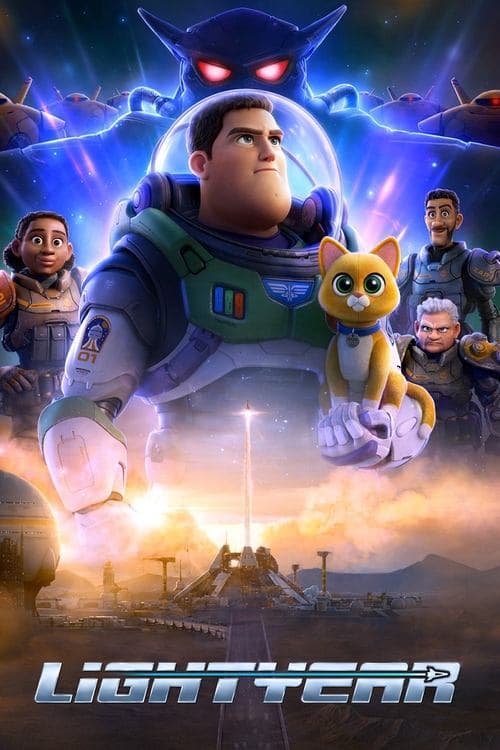
Vibe
Pixar’s sci-fi adventure reimagines Buzz Lightyear as a space ranger navigating a high-stakes mission on a distant planet, where a failed hyperspace test strands his crew and forces him into a relentless cycle of time-altering attempts to make things right. As each mission advances time around him, Buzz remains unchanged, gradually losing connection with those he’s trying to save while confronting the consequences of his singular focus on perfection. Directed by Angus MacLane, the film blends classic space opera elements with a more introspective character arc, shifting from external heroism to internal reckoning. Lightyear becomes a story about failure, control, and the realization that progress often requires accepting imperfection and relying on others.
Watch for
- Buzz’s repeated hyperspace missions, illustrating the passage of time and its emotional impact.
- The evolving team dynamic, which challenges Buzz’s tendency toward isolation.
- The visual contrast between Buzz’s perspective and the world changing around him.
- The final confrontation, where Buzz must reconcile his ideals with the reality of growth and compromise.
Production notes
Lightyear was directed by Angus MacLane, a longtime Pixar veteran (he had co-directed Finding Dory) and was conceived as an in-universe meta-movie: 'the movie that inspired the toy that Andy got for his birthday in Toy Story.' The film's framing device opened with a title card explaining this premise. MacLane developed the project as a serious science-fiction film in the tradition of 1980s and 1990s space adventures (Aliens, Star Wars, 2001) rather than as a Toy Story spinoff. Chris Evans replaced Tim Allen as the voice of Buzz Lightyear — the studio explicitly stated that Allen voiced the toy in Toy Story while Evans was voicing the in-universe space ranger character. The cast included Keke Palmer as Izzy Hawthorne, Taika Waititi as Mo Morrison, Dale Soules as Darby Steel, and James Brolin as Zurg. Composer Michael Giacchino contributed his sixth Pixar score. The film was released theatrically on June 17, 2022 — Pixar's first theatrical release after Toy Story 4 in 2019. Production cost approximately $200 million.
Trivia
- Lightyear's premise — that the film is the in-universe blockbuster that inspired the Buzz Lightyear toy in Toy Story — was a structural conceit unique in animated franchise history; the framing device opens the film with a title card explaining the premise, and many casual viewers didn't catch it.
- Chris Evans replaced Tim Allen as the voice of Buzz Lightyear, with Pixar explicitly framing Evans's performance as the in-universe space ranger and Allen's previous performances as the toy version of the character; Allen was reportedly unhappy with not being asked to return.
- The film featured Pixar's first on-screen same-sex kiss between two female characters (Izzy's mothers Hawthorne and Alisha); the kiss had been initially cut from the film by Disney executives, then restored after public objection from Pixar staff.
- Lightyear was banned in 14 countries — primarily in the Middle East and Asia — over the same-sex kiss; the bans contributed to the film's underperformance in international markets, though Disney's commitment to the kiss became a public stand for the studio's representation policies.
- The film grossed approximately $226 million worldwide on a $200 million budget — making it Pixar's most commercially disappointing major theatrical release of the modern era and contributing to internal debate about Pixar's franchise direction.
Legacy
Lightyear was Pixar's most commercially disappointing theatrical release of the modern era — a $226 million worldwide gross on a $200 million budget meant the film failed to break even theatrically. The reasons for its underperformance have been extensively analyzed: the unusual in-universe meta-movie framing confused casual audiences who expected a Toy Story extension; the bans in 14 countries over the same-sex kiss limited international reach; the post-pandemic theatrical recovery for animated films was fragile; and the film arrived in a release window where original sci-fi struggled. Critically the film received mixed reviews, with most reviewers acknowledging strong technical achievement but treating the project as a curious branding exercise rather than a essential addition to the Toy Story canon. The film's commercial failure contributed to Disney's renewed scrutiny of Pixar's release strategy, and to subsequent discussions about whether the studio could profitably make original (non-Toy-Story-non-Inside-Out) content in the post-pandemic theatrical environment.