Finding Nemo
Vibe
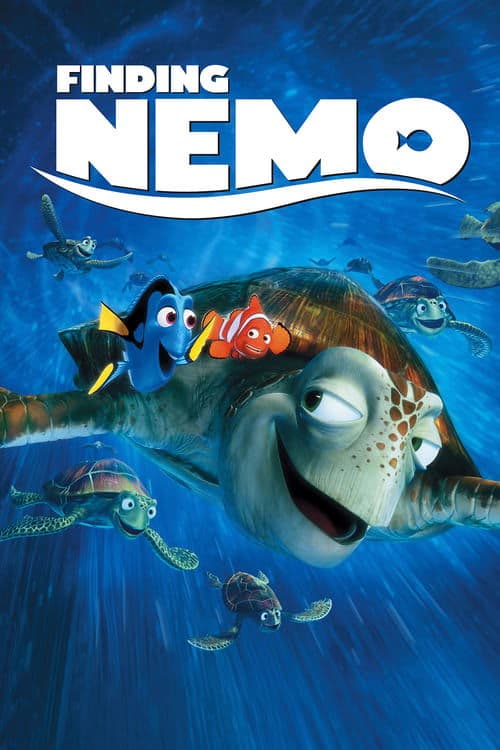
Pixar’s oceanic adventure follows Marlin, an overprotective clownfish whose worst fears are realized when his son Nemo is captured by a diver and taken far from the safety of their reef. Determined to rescue him, Marlin sets out across the vast and unpredictable ocean, joined by Dory, a forgetful yet optimistic blue tang whose unwavering spirit challenges his cautious nature. As Nemo navigates his own journey in captivity, both father and son are forced to grow in ways neither expected. Directed by Andrew Stanton, the film combines breathtaking underwater visuals with a deeply emotional story about parenthood, trust, and letting go. Balancing humor, danger, and heart, Finding Nemo remains one of Pixar’s most universally resonant and visually immersive films.
Watch for
- Marlin and Dory’s contrasting personalities, which drive both the humor and emotional growth throughout the journey.
- The shifting ocean environments, each presenting new visual challenges and storytelling opportunities.
- Nemo’s parallel storyline in the aquarium, reflecting themes of independence and courage.
- The East Australian Current sequence, where momentum, energy, and character interplay come together in a memorable set piece.
Production notes
Finding Nemo was Andrew Stanton's directorial debut — though he had been an essential writer on every Pixar feature since Toy Story, this was his first solo directing credit. Stanton, whose own son had been diagnosed with autism, drew on his anxieties as a parent to shape Marlin's arc, and the team built the film around the father-son relationship as its emotional core. The studio sent animators to scuba diving classes and to the Monterey Bay Aquarium for extensive reference work, and developed entirely new tools for simulating water, light scattering, and underwater motion. Albert Brooks voiced Marlin, Ellen DeGeneres played Dory in a role written specifically for her, and Alexander Gould played young Nemo. The voice cast also included Willem Dafoe as Gill, Geoffrey Rush as Nigel the pelican, and Pixar regular John Ratzenberger. The film cost approximately $94 million and took roughly four years to produce.
Trivia
- The character of Dory was written specifically for Ellen DeGeneres after Andrew Stanton heard her vocal cadence on her sitcom and decided he wanted exactly that voice for the character — DeGeneres later said the role saved her career, which had been in a difficult period.
- Pixar's animators consulted with marine biologist Adam Summers from UC Irvine, who became known internally as 'Fabio' because of his hair; the team showed him every fish design and motion sequence to ensure scientific accuracy.
- The film unintentionally caused a real-world surge in clownfish purchases for home aquariums — and a corresponding surge in clownfish deaths from improper care — that environmental groups have continued to flag with each subsequent screening.
- Pixar developed an entirely new lighting and rendering system for water; the film's underwater visuals were sophisticated enough that real marine biologists used scenes from the movie in classroom teaching.
- Andrew Stanton has said the line 'Just keep swimming' was the spine of the film for him from the earliest story phase — it captures both the literal action and the emotional message simultaneously.
Legacy
Finding Nemo demonstrated Pixar's ability to fuse technological achievement with deeply emotional storytelling on a grander scale than any of its previous films. It grossed over $940 million worldwide on first release — the highest-grossing animated film at the time of release — and won the Academy Award for Best Animated Feature, with three additional nominations. The film entered the National Film Registry in 2024. Its 2016 sequel Finding Dory grossed $1.03 billion. Beyond box office, the film reshaped public consciousness about marine life in ways that environmental educators have studied extensively; it also reset what audiences expected from Pixar — that a film could be both visually transcendent and emotionally heavy, that family-film themes could include genuine grief and parental anxiety. The clownfish, blue tang, sea turtle, and pelican characters joined the upper rank of Pixar's merchandising roster, and the 'just keep swimming' refrain has entered popular culture as a shorthand for resilience under pressure.