Finding Dory
Vibe
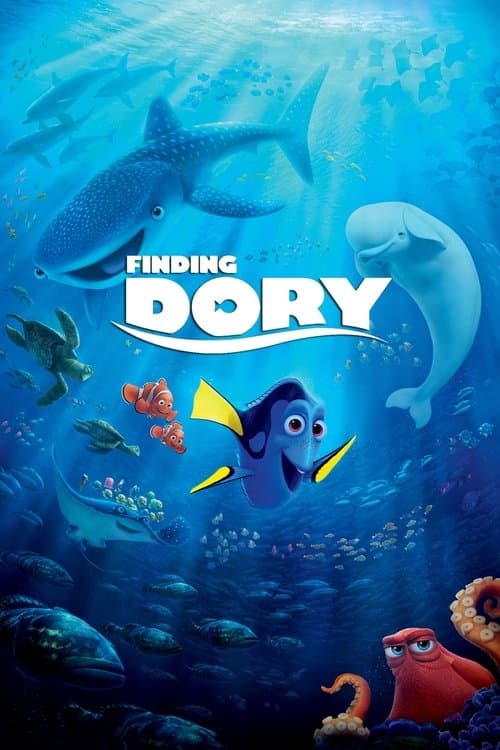
Pixar’s sequel shifts focus to Dory, the forgetful yet optimistic blue tang who begins to piece together fragments of her past and sets out on a journey to find her long-lost parents. Joined once again by Marlin and Nemo, Dory navigates a series of challenges that lead her to a marine life institute, where memories resurface in unexpected ways. As her search unfolds, the film balances humor and chaos with a deeper emotional thread centered on identity and belonging. Directed by Andrew Stanton, the story reframes Dory’s forgetfulness not as a limitation but as a defining part of who she is. Finding Dory becomes a story about self-acceptance, perseverance, and the enduring pull of family.
Watch for
- Dory’s memory triggers, which gradually reveal her past and drive the narrative forward.
- The marine life institute setting, providing new environments and character interactions.
- The supporting characters, particularly those who mirror Dory’s sense of displacement and adaptation.
- The moments of reunion and realization, where the film’s themes of belonging and acceptance come into focus.
Production notes
Finding Dory was Andrew Stanton's first Pixar feature after his troubled live-action film John Carter (2012), and his return to the underwater world he had built for Finding Nemo 13 years earlier. Stanton developed the story around a question that had been bothering him: what would actually happen to Dory given her short-term memory loss? The answer became the spine of the sequel. Ellen DeGeneres returned as Dory, with Albert Brooks reprising Marlin and Hayden Rolence taking over Nemo. New cast included Ed O'Neill as Hank the septopus, Kaitlin Olson as Destiny the whale shark, Ty Burrell as Bailey the beluga, Diane Keaton and Eugene Levy as Dory's parents, and Idris Elba and Dominic West as the cockney sea lions. The film required Pixar to develop new tools for skin transparency and water-light interaction that exceeded what Finding Nemo had achieved. Production cost approximately $200 million.
Trivia
- Hank the septopus (an octopus with seven tentacles, having lost one) was reportedly the most technically challenging character in Pixar's history at the time of production — the team developed an entirely new rigging system for octopus-style fluid movement.
- Ellen DeGeneres had publicly campaigned for a Finding Nemo sequel for years; Andrew Stanton has said the breakthrough came when he realized Dory's short-term memory loss was a genuine emotional condition deserving its own story rather than a comic device.
- Diane Keaton was specifically cast as Dory's mother, Jenny, because Stanton wanted the maternal voice to suggest the character's lifelong love and worry; her single line readings during the recording sessions reportedly moved the production team to tears.
- Finding Dory opened to the highest-grossing animated film opening weekend in US history at the time of its 2016 release, grossing $135 million domestically — surpassing Toy Story 3's previous record.
- The film was originally planned for November 2015 release but was delayed to June 2016 to give the team additional time on the technical innovations the underwater rendering required, and to avoid release-window collision with The Good Dinosaur.
Legacy
Finding Dory deepens the emotional and thematic terrain of Finding Nemo, exploring memory, family, and self-acceptance through Dory's perspective in ways the original couldn't have done with her as a supporting character. It grossed approximately $1.03 billion worldwide on a $200 million budget — Pixar's third billion-dollar release after Toy Story 3 and the eventual sequels — and earned critical praise as one of the studio's strongest sequels. The film's portrayal of disability and learning difference (Dory's short-term memory loss treated with seriousness, the octopus Hank's missing tentacle, Destiny's poor eyesight, Bailey's echolocation difficulties) was widely cited by disability advocates as among the most thoughtful in mainstream animation. The film has had quiet but durable afterlife on streaming, and Dory has become a permanent fixture of Pixar's character roster across merchandise, theme parks, and short-form content. As Pixar's most critically and commercially successful sequel of the 2010s, Finding Dory is a case study in how a long gap between original and follow-up can deepen rather than dilute a property.