Coco
Vibe
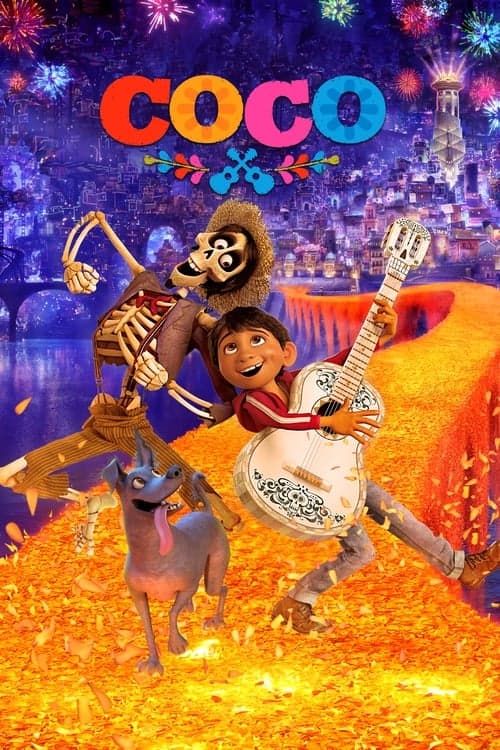
Pixar’s vibrant musical adventure follows Miguel, a young boy in Mexico who dreams of becoming a musician despite his family’s long-standing ban on music. On Día de los Muertos, Miguel is mysteriously transported to the Land of the Dead, where he seeks out his ancestors in hopes of uncovering the truth behind his family’s history. Along the way, he forms an unlikely bond with Héctor, a charming but forgotten soul who becomes key to his journey. Directed by Lee Unkrich, the film blends rich cultural detail with dazzling visual design, creating a world that celebrates memory and tradition. Beneath its colorful spectacle lies a deeply emotional story about family, legacy, and the enduring power of remembrance.
Watch for
- The visual design of the Land of the Dead, filled with color, scale, and intricate detail.
- Miguel’s relationship with Héctor, which evolves as the truth of the story unfolds.
- The role of music as both a narrative device and emotional anchor throughout the film.
- The final moments of remembrance, where the film’s themes of family and legacy come into focus.
Production notes
Coco was directed by Lee Unkrich (Toy Story 3) with co-director Adrian Molina, and represented Pixar's most extensive cultural research effort to that point. The team made multiple trips to Mexico, including extended stays in Oaxaca, Mexico City, and Guanajuato during Día de los Muertos — the Mexican holiday at the center of the film's premise. Pixar formed a 'cultural consultants' team that advised on everything from family dynamics to architectural detail to musical traditions, and the film deliberately developed an all-Latino voice cast — a Pixar first. Anthony Gonzalez voiced Miguel, Gael García Bernal played Héctor, Benjamin Bratt was Ernesto de la Cruz, and Renée Victor played Abuelita. Composer Michael Giacchino brought in Mexican musicians Camilo Lara and Germaine Franco as co-composers, and 'Remember Me' was written by Frozen songwriters Robert Lopez and Kristen Anderson-Lopez. The film cost approximately $175 million and took six years to develop.
Trivia
- Coco was Pixar's first feature with an all-Latino principal cast and the studio's most extensive cultural consultation process to date; the team spent multiple years working with Mexican advisors on family dynamics, traditions, and visual detail.
- The film's 'Land of the Dead' sequences feature thousands of skeleton characters, each individually rigged and animated; the technical challenge of differentiating skeletons through clothing, accessories, and gesture led to new animation tools.
- 'Remember Me' was written by Robert Lopez and Kristen Anderson-Lopez, who had previously won an Academy Award for 'Let It Go' from Frozen (2013); the song won the 2017 Academy Award for Best Original Song, making the Lopezes one of only a handful of two-time Oscar winners in the category.
- The film delayed its Mexico release from late 2017 to early 2018 specifically to coincide with Día de los Muertos celebrations; in Mexico, the film grossed over $59 million, becoming one of the highest-grossing animated films in Mexican history.
- Lee Unkrich, the director, had been with Pixar since 1994 (he had been an editor on Toy Story); Coco was his last project as a Pixar director before he left the studio in 2019 to work on a passion project about The Shining.
Legacy
Coco was a creative and commercial triumph that significantly expanded what audiences expected from Pixar — both as an emotional experience and as a representational achievement. It grossed about $814 million worldwide on a $175 million budget, won two Academy Awards (Best Animated Feature, Best Original Song for 'Remember Me'), and was particularly extraordinarily received in Mexico, where it became one of the highest-grossing films in the country's history. The film has had enormous downstream cultural impact: Mexican audiences embraced it as one of Hollywood's most genuinely respectful engagements with Mexican tradition, and Día de los Muertos awareness in non-Latin markets increased significantly after the film's release. A sequel, Coco 2, was announced in March 2025 with Adrian Molina returning to direct, after he stepped away from Elio. The film entered the National Film Registry in 2025. Among Pixar's films, Coco is the most-cited example of how cultural specificity rather than dilution can achieve universal emotional reach.