Cars 2
Vibe
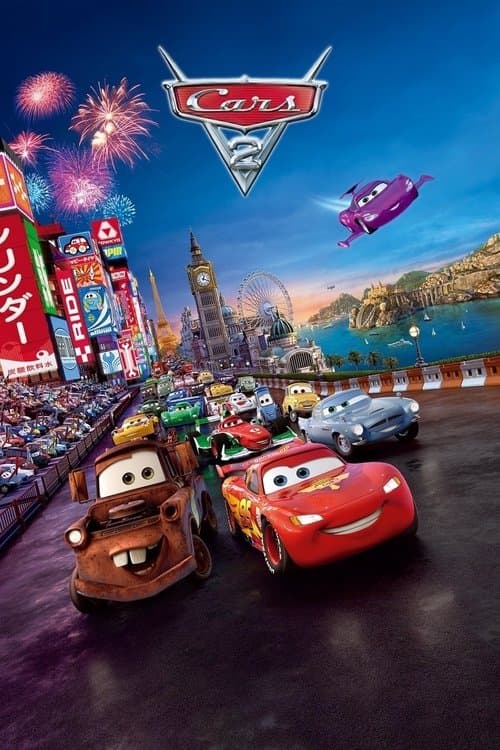
Pixar’s globe-trotting sequel shifts focus to Mater, the well-meaning tow truck who finds himself unexpectedly drawn into an international spy adventure while accompanying Lightning McQueen on the World Grand Prix. Mistaken for a covert operative, Mater becomes entangled with British agents investigating a conspiracy that threatens the future of racing itself. As the story moves across a series of international settings, the film blends espionage tropes with broad comedy, placing Mater’s innocence at the center of the narrative. Directed by John Lasseter, Cars 2 trades the reflective tone of its predecessor for a faster, more chaotic energy. Beneath its spectacle, the film explores ideas of identity, self-worth, and the importance of staying true to oneself in unfamiliar environments.
Watch for
- Mater’s interactions with the British agents, highlighting the contrast between his simplicity and the complexity of espionage.
- The international race locations, each adding visual variety and scale to the story.
- The spy sequences and gadget-driven action, which parody classic espionage films.
- Mater’s realization of his own value, grounding the film’s emotional arc amid its fast-paced narrative.
Production notes
Cars 2 was John Lasseter's return to feature directing after he had stepped back to oversee Pixar and Disney Animation Studios as Chief Creative Officer following the 2006 Disney–Pixar acquisition. The film pivoted the franchise in a radically different direction from the small-town original — into a globe-spanning espionage thriller modeled on James Bond and Cold War spy cinema, with Mater elevated to co-protagonist alongside Lightning McQueen. The team did extensive international research, with trips to Tokyo, Paris, London, and the Italian Riviera shaping the film's sequence of locations. Owen Wilson and Larry the Cable Guy returned, joined by Michael Caine as the British secret agent Finn McMissile, Emily Mortimer as Holley Shiftwell, and Eddie Izzard as the villain Miles Axlerod. Composer Michael Giacchino, fresh from his Mission: Impossible — Ghost Protocol score, brought a deliberately Bond-influenced sensibility. The film cost approximately $200 million.
Trivia
- Cars 2 was Pixar's first feature film to receive 'rotten' status on Rotten Tomatoes, ending a streak of 11 consecutive 'fresh' Pixar releases dating back to Toy Story (1995); the streak's end became a watershed moment in conversations about the studio's quality consistency.
- John Lasseter's decision to return as director — and to elevate Mater to co-protagonist — was reportedly controversial within Pixar, with several senior creatives skeptical of the franchise's direction; the disagreements would later be cited in coverage of Lasseter's eventual 2018 departure from the studio.
- Michael Caine, who voiced Finn McMissile, was 78 when he recorded the role; the character was deliberately modeled on his own past performances in classic British spy films like The Ipcress File (1965).
- The film's Tokyo sequences include detailed background recreations of Shibuya Crossing and other recognizable Tokyo landmarks, modeled from on-location reference photography by Pixar's research team.
- Cars 2 was Pixar's first sequel that grossed less than its predecessor in domestic box office; despite that, it remained extremely commercially successful internationally, particularly in Asian markets where the original Cars had also outperformed expectations.
Legacy
Cars 2 is widely regarded as Pixar's first creative misstep — the film whose disappointing critical reception, after 11 straight 'fresh' Rotten Tomatoes releases, marked the end of a decade-long streak and forced the studio's first serious external reassessment of its own quality. It grossed about $562 million worldwide on a $200 million budget — commercially solid, but underperforming relative to the Pixar standard. The film's commercial life has been driven primarily by international markets, particularly Asia, and by extraordinary toy and merchandise sales that have continued for over a decade. The franchise's underlying commercial strength has remained robust enough to support Cars 3 (2017), the Cars on the Road Disney+ series, the Planes spinoffs, and the Cars Land at Disney California Adventure. As the Pixar film most often cited in discussions of when the studio 'lost its way,' Cars 2 carries an outsized historical weight that exceeds its modest creative reputation — a useful case study in how internal momentum can outpace external reception.