Cars
Vibe
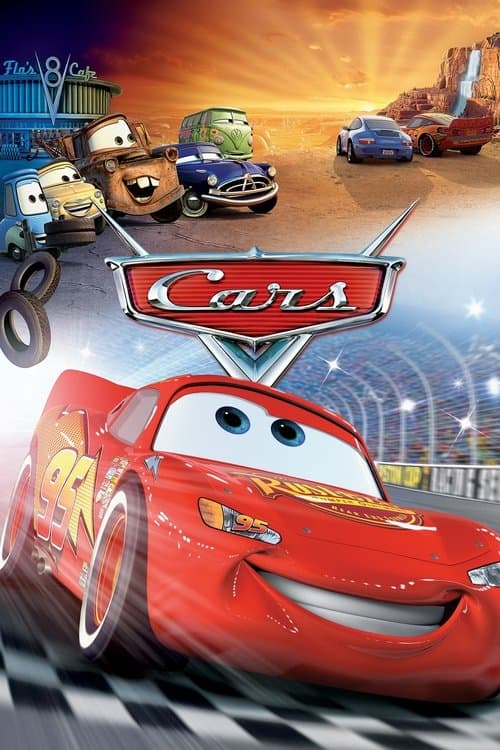
Pixar’s road trip tale follows Lightning McQueen, a rising race car whose obsession with winning leads him to a forgotten desert town along Route 66 after a chance detour leaves him stranded. Forced to slow down and repair the damage he’s caused, McQueen gradually forms connections with the town’s residents, including the wise Doc Hudson and the spirited Sally. As he begins to understand the value of community over individual success, his definition of winning is fundamentally challenged. Directed by John Lasseter, the film trades high-speed spectacle for a more reflective pace, blending Americana nostalgia with character-driven storytelling. Beneath its racing premise lies a meditation on ambition, humility, and the importance of slowing down to find meaning.
Watch for
- Lightning McQueen’s initial arrogance and gradual transformation as he adapts to life in Radiator Springs.
- Doc Hudson’s backstory, which reframes the film’s themes of legacy, loss, and second chances.
- The detailed world-building that brings a human-like society of cars to life with humor and authenticity.
- The final race, where McQueen’s choices reflect his changed values and redefine what it means to win.
Production notes
Cars was John Lasseter's personal passion project, born from a 2000 cross-country road trip he took with his wife and five sons after years of overwork on Toy Story 2. The trip rekindled his love of Route 66 and small-town America, and the resulting film became a deliberate love letter to a fading highway culture. Production was unusually challenging — depicting cars as characters required entirely new approaches to facial animation through windshields and headlights, and the racing sequences demanded sustained high-speed photorealism. Owen Wilson voiced Lightning McQueen, Paul Newman played Doc Hudson in his final substantial film role before his death in 2008, and the cast included Bonnie Hunt, Larry the Cable Guy as Mater, and George Carlin as the hippie van Fillmore. Composer Randy Newman scored the film. The film cost approximately $120 million and took roughly four years to produce.
Trivia
- Paul Newman, who voiced Doc Hudson, was 81 when he recorded the role and a lifelong racing enthusiast — he had won 35 SCCA national racing championships and continued racing professionally into his 80s; the character's racing legacy was directly modeled on Newman's own.
- John Lasseter took his five sons on the cross-country road trip that inspired the film in 2000; the experience reshaped his approach to work-life balance at Pixar and directly informed the film's themes about slowing down and human connection.
- Radiator Springs was modeled on real Route 66 towns including Galena and Baxter Springs, Kansas; Tucumcari, New Mexico; and Seligman and Williams, Arizona — Pixar's research team visited the route extensively for reference.
- The film was personally championed by Lasseter against significant internal skepticism — some Pixar veterans argued the premise was thin and the story stalled in development, but Lasseter's authority as Disney/Pixar's chief creative officer kept the project moving forward.
- Cars became Pixar's most successful merchandising franchise to date, generating over $10 billion in retail sales of toys, apparel, and licensed products — vastly outperforming even Toy Story in pure merchandise terms.
Legacy
Cars showcases Pixar's sentimental side, celebrating community, slowing down, and the values of small-town America in an era of corporate sprawl. It grossed about $462 million worldwide and earned two Academy Award nominations (Best Animated Feature, Best Original Song for Randy Newman's 'Our Town'). Critically, the film received Pixar's softest reviews to that point — the studio's first feature widely treated as 'minor' rather than as masterwork — but its commercial and merchandising performance was extraordinary. The franchise has grown to include two theatrical sequels (Cars 2 in 2011, Cars 3 in 2017), the Planes spinoff films, the Cars Land at Disney California Adventure (which opened in 2012 at a reported $1.1 billion construction cost), Cars on the Road on Disney+, and an enormous toy and merchandise empire. Cars is the Pixar feature most often described as more commercially significant than critically beloved — and the one whose theme park presence and sales footprint have most exceeded its theatrical reputation.